
Ant Control in Toronto & the GTA
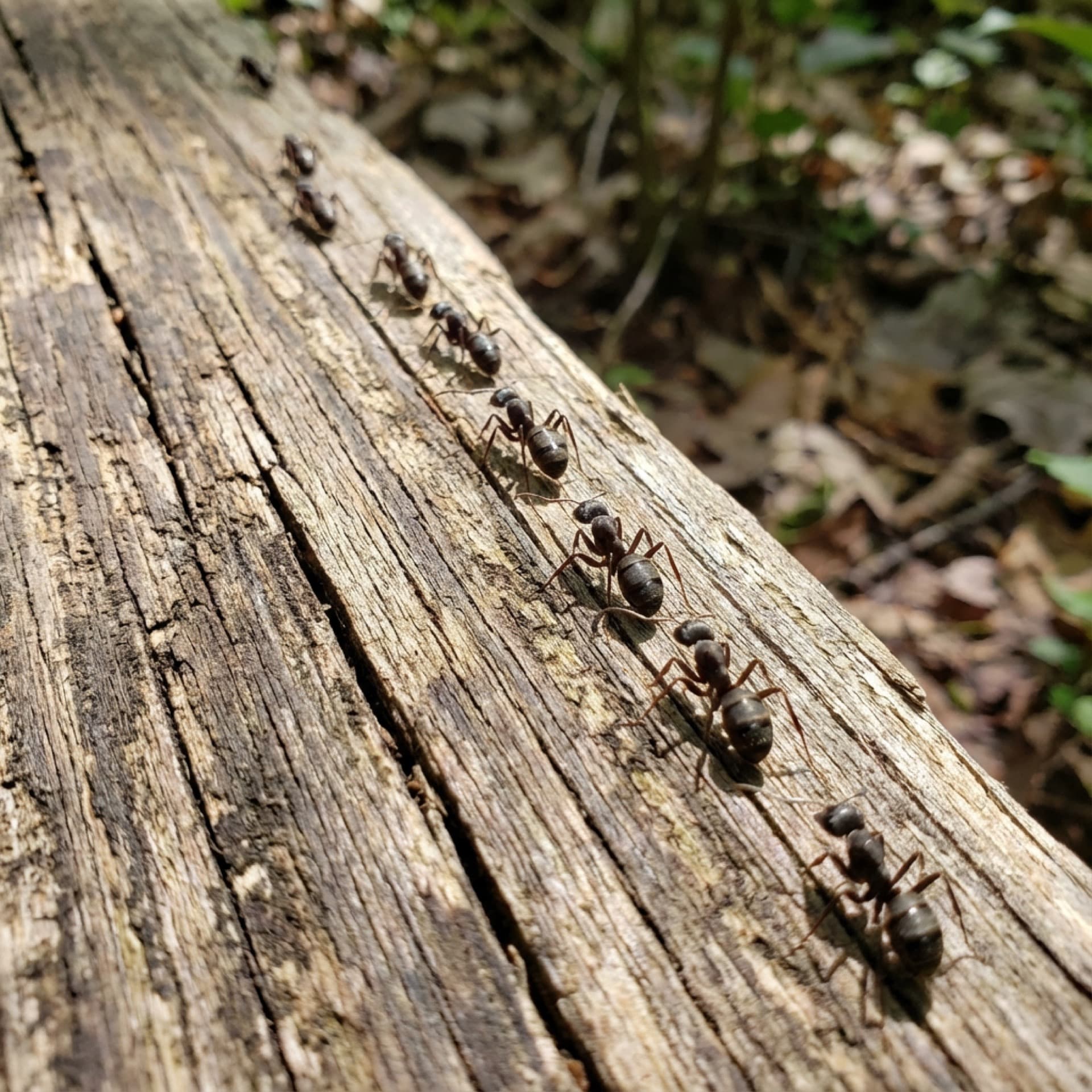
Ant problems in GTA homes typically involve one of three species: carpenter ants (Camponotus pennsylvanicus), pavement ants (Tetramorium immigrans), or odorous house ants (Tapinoma sessile). Each requires a different response. Identifying the species before treating is not academic — applying the wrong product or method to the wrong species either fails or makes the problem worse.
Carpenter ants are the most structurally significant. They do not eat wood — they excavate it to create galleries for nesting, ejecting frass (coarse sawdust mixed with insect body parts) from small holes in the wood. A carpenter ant nest inside a wall cavity or in a structural beam represents progressive structural damage. They prefer wood that has been softened by moisture, so carpenter ant activity inside a home is often an indicator of a moisture problem — a leaking window frame, a roof leak above the nesting area, or a chronic plumbing drip.
Pavement ants and odorous house ants are nuisance species that forage for food inside the home but typically nest outdoors — in the soil under slabs, along foundation edges, or under paving stones. Treatment that only targets the foraging ants inside the home will fail; the colony must be disrupted at the nest.
Ant pressure in the GTA follows a predictable annual cycle, and when you call tells us a lot about what you are dealing with. Colonies become active again as ground temperatures rise through March and April, which is when scouts first turn up along kitchen counters and window sills. Foraging peaks through the summer, and this is also when winged reproductives appear — a swarm indoors in spring is a strong indicator that a carpenter ant nest is already established in the structure rather than in a tree outside. Activity tapers through the autumn as outdoor colonies move toward dormancy. The one pattern that overrides all of this is winter activity: pavement and odorous house ant colonies outside go quiet in the cold, so ants still moving through a heated home in January or February point to a nest indoors.
- Licensed & insured — Ontario Reg. 63/09
- Same-day & next-day service
- Humane methods
- 5-year warranty on sealing work
- Across the GTA, Oakville to Oshawa
- 24/7 emergency line
Signs of an ant infestation
- Carpenter ant specific: coarse frass (brown sawdust mixed with darker debris) near a wall, window frame, or structural timber — this is the clearest sign of active tunnelling
- Large black ants (10–15 mm) seen inside the home, particularly in the kitchen or near windows, during spring and summer
- Small ant trails along baseboards, countertops, or window sills — foraging trails of pavement or odorous ants following a food source
- Ant activity concentrated near moisture sources: under the kitchen sink, around a bathroom dripping fixture, near a window that is slow to close fully
- Winged ants (swarmers) seen inside the home in spring — a swarm inside a home strongly suggests a carpenter ant nest is already established in the structure
- Pavement ant mounds (small craters of disturbed soil) along the edge of the driveway, between paving stones, or along the foundation wall
How we handle it
Species identification and nest location
We identify the species involved and attempt to locate the nest — carpenter ant nests inside the structure, outdoor colony entry points for pavement and odorous house ants. Treatment aimed at the nest is far more effective than targeting foragers.
Targeted treatment
Carpenter ants: residual insecticide is applied to the nest void if accessible, and to the perimeter of the structure and entry points. Pavement and odorous ants: granular or gel bait is applied near the colony exterior entry points and nest sites. Transfer baits work by having foragers carry lethal material back to the queen.
Moisture source identification
For carpenter ants specifically, we identify any moisture issues contributing to the nest site — softwood from a slow leak, condensation on a poorly insulated exterior wall, or drainage accumulating against the foundation. Eliminating the moisture reduces the future attractiveness of the same area.
Perimeter barrier and follow-up
A residual barrier treatment is applied around the foundation and entry points to prevent re-entry. A follow-up visit at 3–4 weeks confirms the population is declining.
Carpenter ant activity inside a home during winter — particularly in February and March — is a reliable indicator the nest is inside the heated structure, not in an outdoor tree or log. Outdoor nests go dormant in winter; indoor nests do not.
View all pest control & wildlife removal services we offer across Toronto and the GTA.
Service Areas for Ant Control
We provide specialized ant control services in the following neighborhoods and cities:
Starting at $395
Final price depends on the animal, the number of entry points, and the sealing work needed. You get a firm quote after the inspection — no surprise charges.
Annual Protection Plan
Year-round coverage for your home or business across the GTA.
View planAnt Control — Frequently Asked Questions
What's the best way to get rid of an ant colony?
Killing the ants you see doesn't touch the colony. We treat so the workers carry the product back to the nest, which deals with the source rather than the symptom, and we seal common entry points.
How do I tell carpenter ants from the ordinary kind?
Size and evidence. Carpenter ants are large — roughly 10 to 15 mm — and they leave coarse frass that looks like brown sawdust mixed with darker debris near a wall, window frame, or beam. Pavement and odorous house ants are much smaller and travel in visible trails along baseboards and counters, with small craters of disturbed soil outside along the driveway or foundation. The difference matters because carpenter ants nest inside the structure and the others usually don't.
When do ants become a problem in the GTA?
Colonies wake up in spring, roughly March through May, and that's when scouts start showing up in kitchens. Activity peaks through the summer as foraging ramps up, then tapers in the fall as outdoor colonies go dormant. Winged ants indoors in spring usually mean an established nest, and carpenter ants still active indoors in February or March mean the nest is inside the heated structure rather than outside.
I only see a few ants. Do I actually need treatment?
The ants you see are foragers, and they're a fraction of the colony. A handful along a counter in spring is often the first sign of a nest that's already established somewhere nearby. Whether it needs treatment depends on the species and where the nest is — with carpenter ants it's worth acting early, because the tunnelling in structural wood is progressive.
Why do the ants keep coming back after I treat them myself?
Store sprays kill foragers and often split the colony into satellite nests, which makes the problem harder to finish. And with carpenter ants there's usually a moisture source keeping the wood soft enough to tunnel — a slow leak, condensation, or drainage sitting against the foundation. Until that's dealt with, the same spot stays attractive to the next colony.
Are you licensed and insured?
Yes. Durapest is licensed by the Ontario Ministry of the Environment and operates in line with Ontario Reg. 63/09. Our technicians are trained and insured for both residential and commercial work.
Do you offer a warranty?
Yes. Treatments come with a warranty, and any sealing or exclusion work is backed by our 5-year warranty. If covered pests return within the warranty period, we come back and re-treat at no extra cost.
How soon can you come out?
We offer same-day and next-day service across most of the GTA, from Oakville to Oshawa, with 24/7 dispatch for emergencies. Call us and we'll give you a straight answer on the next available slot for your area.